Categories
Browse articles by topic below.Stay Tuned
Want to become a Next.js pro?
The best articles, links and news related to web development delivered once a week to your inbox.Latest Articles
Thoughts and write-ups on backend development, Python, and AI-assisted engineering.
Page 1/1
SQLite vs MySQL vs PostgreSQL vs MongoDB vs Firebase: Which Database Should You Use?
Five databases that get compared constantly, and almost never on the axis that actually matters — what your data looks like and who else needs to write to it at the same time. A practical, use-case-first breakdown.- Published on
Vercel vs Railway: Which Should You Deploy To?
Vercel and Railway solve different deployment problems even though they're often compared head to head. A practical breakdown of where each one actually fits, based on what kind of backend you're running.- Published on
Why AI-Generated Code Still Needs an Experienced Software Engineer
AI can write working code faster than most humans. It still can't tell you whether that code should exist, what it's quietly assuming, or what happens when it's wrong. Notes from actually shipping with it.- Published on
How I Would Design an AI Application in Production
The interesting engineering problems in an AI-powered application aren't the model calls — they're everything around them. A practical architecture for latency, cost, failure, and the fact that the model will sometimes be wrong.- Published on
I Built a Production-Style Python API With Claude — Here's Exactly What Happened
An honest, evidence-based account of building a FastAPI + PostgreSQL + Redis + Celery task management API with Claude — including the real bugs, the real fixes, and where AI assistance actually helped versus where engineering judgment still mattered.- Published on
Building a Production-Ready FastAPI Backend in 2026
A practical checklist for the parts of a FastAPI project that don't show up in the getting-started tutorial — project structure, configuration, dependency injection, testing, and the operational basics that decide whether it survives contact with real traffic.- Published on
From Python Script to Production API
Most APIs start as a script that worked once on someone's laptop. Here's the specific, concrete set of changes that separates that script from something you can hand to another team and trust.- Published on
Building a Personalized AI Text Prediction System with LSTM and GRU
A practical walkthrough of next-word text prediction with recurrent networks — why LSTM and GRU exist at all, how they actually differ, and what "personalized" really means once you have to train on one person's writing instead of a huge generic corpus.- Published on
How to Automate a Manual Business Process With Python
Most manual business processes aren't automated because they're technically hard — they're skipped because nobody mapped the process before reaching for code. A practical framework for picking the right process and automating it properly.- Published on
How Web Scraping Can Save Businesses Hundreds of Hours
Manual research doesn't scale — a person checking competitor prices or copying leads into a spreadsheet is doing, by hand, exactly what a script does in seconds. A practical look at where web scraping pays for itself, how to build it responsibly, and where the real limits are.- Published on
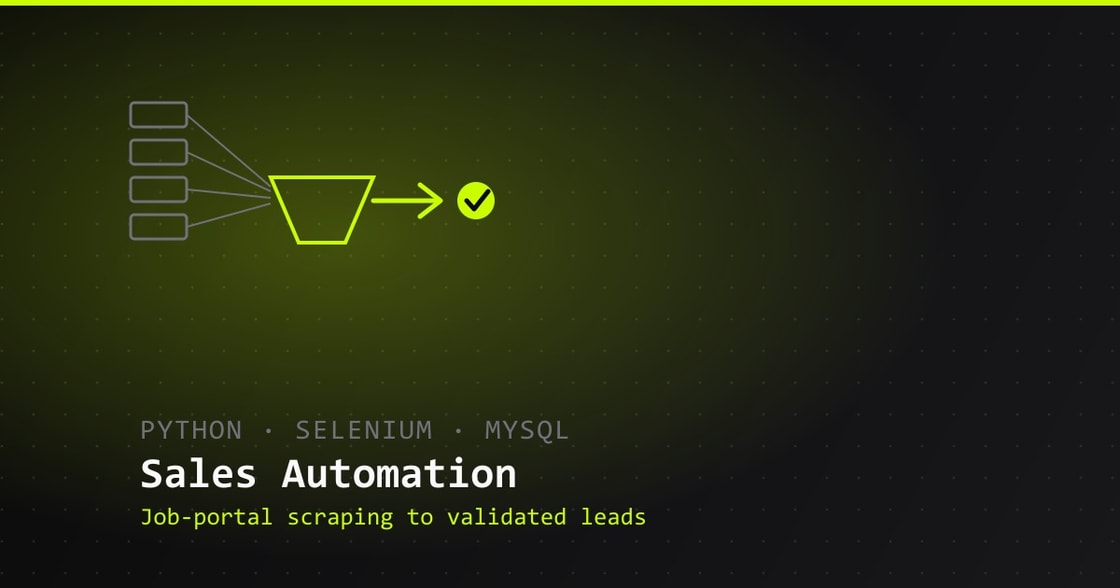
What My First Job Taught Me About Building Automation That Doesn't Break
Lessons from building a production lead-generation pipeline at my first job at InvoZone — on scrapers that break, data that compounds errors downstream, and the difference between code that works once and code that has to keep working.- Published on
Page 1 of 1